# Glasses and Contacts vs. Laser Vision Correction
Glasses and contacts correct vision without surgery — no healing, no surgical risk, and full reversibility — while laser vision correction offers freedom from daily eyewear after a one-time procedure and recovery. Neither is objectively better: the right choice depends on your prescription, lifestyle, risk tolerance, and budget over time.
Key takeaways
- This is a lifestyle decision, not a medical hierarchy — glasses, contacts, and laser correction are all legitimate; the "best" option is the one that fits your life.
- Glasses win on simplicity and safety; contacts win on natural vision and active lifestyles; laser correction wins on long-term convenience.
- Cost comparisons must span years: eyewear has ongoing costs, while surgery is mostly upfront — but financing, enhancements, and reading glasses later complicate the math.
- Laser correction does not end the eyewear story — presbyopia (reading glasses) still arrives on schedule in your 40s.
- Risk tolerance is personal: some people rationally prefer the zero-surgical-risk path even when they are perfect laser candidates.
On this page
- The honest framing
- What glasses do best
- What contact lenses do best
- The ongoing cost and hassle of eyewear
- What laser vision correction offers
- What laser correction cannot do
- A lifestyle-based decision framework
- Frequently asked questions
- Your concrete next step
The honest framing
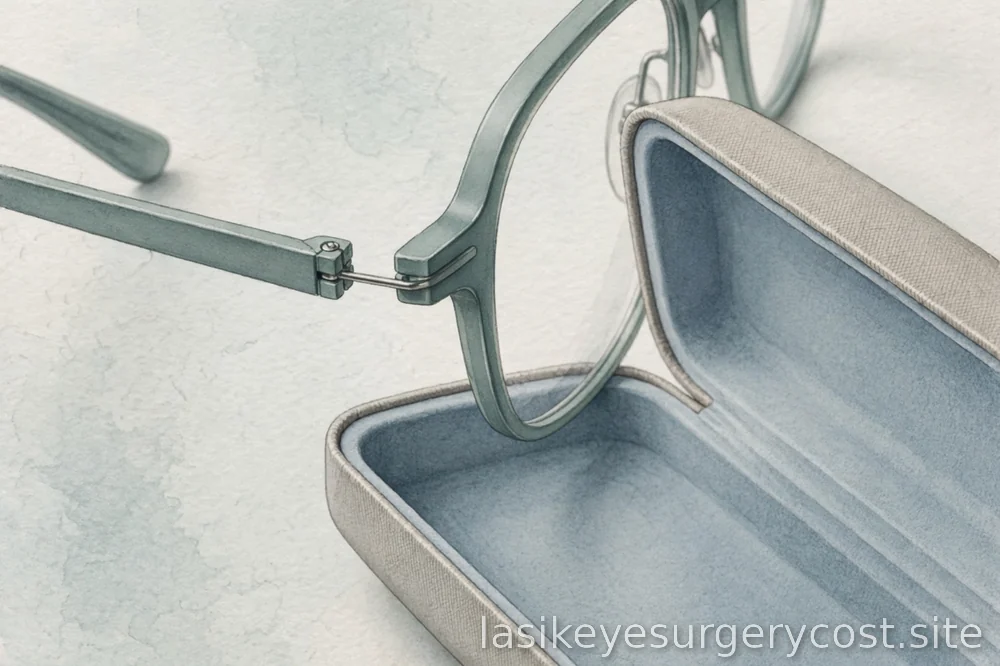
Vision-correction marketing often presents laser surgery as the finish line — the thing you graduate to once you are tired of glasses. That framing is backwards. Glasses and contacts are not the waiting room for surgery; they are complete, valid, lifelong vision correction in their own right, chosen by hundreds of millions of people who could afford surgery and simply prefer not to have it.
The useful question is not "which is best" but "which set of trade-offs do I want to live with." Every option in this comparison asks you to pay something — money, convenience, comfort, or risk — and gives you something back. Lay the trades out honestly and the right answer for your life usually becomes clear.
What glasses do best
Glasses are the simplest vision correction ever invented, and simplicity is underrated:
- Zero medical risk. No surgery, no healing, no side effects beyond the occasional headache from a wrong prescription. For the risk-averse, this alone can settle the debate.
- Instantly reversible and adjustable. Prescription changes? New lenses. Style changes? New frames. No commitment, no recovery, no permanence.
- Eye protection. Frames provide a physical barrier against dust, wind, and minor impacts — and prescription sunglasses solve the sun problem elegantly.
- Fashion and identity. For many people, glasses are part of how they look — not a burden to escape.
- Low ongoing effort. No insertion, no removal rituals, no hygiene protocols, no solutions to buy weekly.
The downsides are familiar: peripheral vision distortion, fogging, slipping during activity, rain on lenses, and the simple fact of having something on your face all day. For high prescriptions, lenses get thick and heavy (high-index materials help, at a cost). None of these are medical problems — they are quality-of-life frictions, and only you can say how much they bother you.
What contact lenses do best
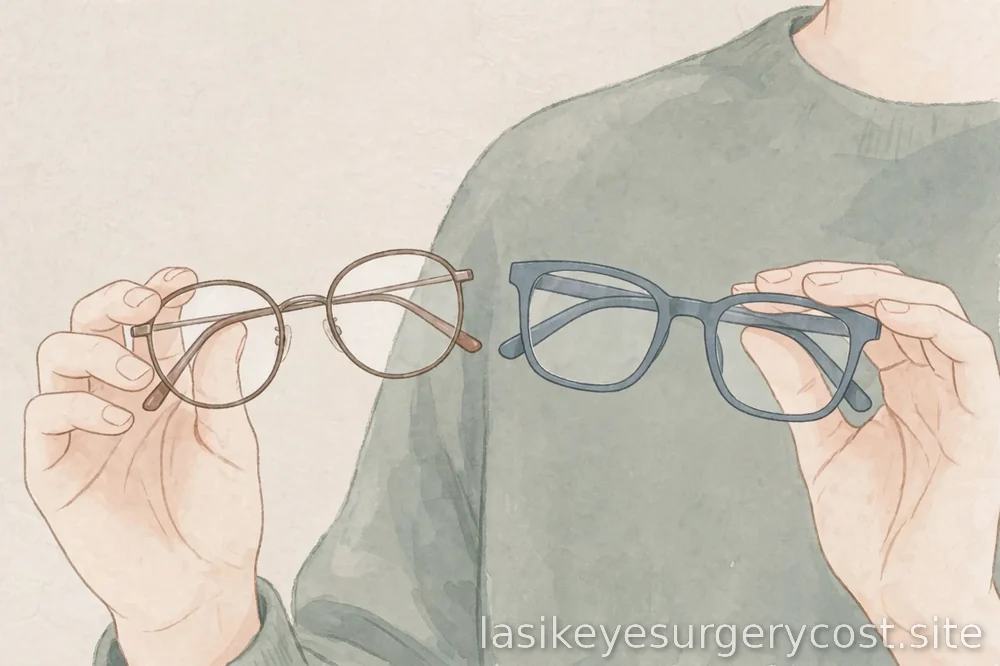
Contacts split the difference: the natural vision of laser correction with the reversibility of glasses.
- Natural field of vision. Contacts move with your eyes, eliminating frame edges and peripheral distortion. For many wearers, vision simply feels more natural than with glasses.
- Freedom during activity. Sports, workouts, outdoor work — contacts stay put where glasses slide, fog, or fall.
- Aesthetics. No frames altering your appearance; sunglasses of any style fit over nothing.
- Good for high prescriptions. Contacts sit on the eye, so even strong prescriptions avoid the thick-lens problem of glasses.
The costs are ongoing and real: daily disposables, cleaning solutions, cases, and regular eye exams for contact lens fittings add up year after year. Hygiene discipline is non-negotiable — sleeping in lenses not approved for it, overwearing them, or handling them with unwashed hands invites infections, including rare but serious corneal infections. Dry eye sufferers often struggle with contacts, and allergies can make certain seasons miserable. Contacts demand a daily ritual of care that glasses never ask for.
The ongoing cost and hassle of eyewear
This is where the comparison gets quantitative — carefully, because your numbers will differ from anyone else's.
Eyewear costs recur: new frames every few years, lens replacements when prescriptions change, contact lens subscriptions, solutions, and the eye exams that go with them. Over a decade or two, the cumulative spend is substantial — which is the core of surgery's financial pitch: pay once (or finance once), then stop paying for correction.
But the honest version of that pitch includes the asterisks. Laser vision correction is mostly upfront, yet financing carries interest; enhancements, if needed, may or may not be included; and reading glasses for presbyopia will very likely enter your life in your 40s regardless — a cost surgery does not eliminate. Some people also keep a glasses pair as backup after surgery.
The right way to compare is total cost over your personal time horizon, with your actual quotes — not anyone's advertised starting price. Our guides to what affects the cost of LASIK and LASIK financing options give you the framework for the surgery side of the ledger.
What laser vision correction offers
Against that backdrop, here is what surgery genuinely buys:
- Freedom from daily eyewear. Wake up seeing clearly, travel without solutions and spare pairs, swim and play sports unencumbered. For people whose lives chafe against eyewear, this is transformative — not medically, but experientially.
- One-and-done (usually). A single procedure, a defined recovery, and then years of reduced dependence on correction. Our overview of what LASIK eye surgery is explains the procedure itself.
- Long-term convenience economics. For younger patients with decades of eyewear costs ahead, the lifetime math often favors surgery — provided the candidacy is solid and expectations are realistic.
- Options beyond LASIK. If LASIK is not suitable, PRK and ICL implants extend the surgical path to many excluded patients.
What surgery costs in exchange: surgical risk (small but real — see our risks and side effects guide), a recovery period, upfront money, and permanence. Laser reshaping cannot be undone, which is precisely why the candidacy screening exists.
What laser correction cannot do
Clear-eyed expectations require knowing the limits:
- It does not stop presbyopia. Around your mid-40s, the eye's natural lens stiffens and near vision declines — LASIK, PRK, and ICL do not prevent this. Most people who have laser correction will still need reading glasses eventually. (Monovision treatments, where one eye is set for near and the other for distance, are a partial workaround some practices offer — with their own trade-offs to discuss.)
- It does not prevent other eye diseases. Cataracts, glaucoma, macular degeneration — the age-related conditions — proceed on their own schedules regardless of prior vision correction.
- It does not guarantee freedom from glasses forever. Prescription regression, enhancement needs, and presbyopia mean many post-surgery patients still own glasses for specific uses.
- It cannot fix every eye. Candidacy limits are real and common — thin corneas, unstable prescriptions, certain diseases, and irregular astigmatism all redirect people back to eyewear or lens implants.
None of this makes surgery a bad deal. It makes it a specific deal — excellent for the right candidate with the right expectations, disappointing for anyone sold a fantasy of permanent perfect vision.
A lifestyle-based decision framework
Instead of asking "which is best," run through these questions:
- How much does eyewear bother you, really? If glasses are a mild annoyance, surgery's benefits may not outweigh its risks for you. If contacts consume your mornings and glasses ruin your sport, the convenience premium is real.
- What is your risk tolerance? Some excellent surgical candidates rationally choose zero surgical risk. That is not fear — it is a values decision, and it deserves respect.
- How old are you? Younger patients get more years of benefit from surgery's upfront cost; patients approaching presbyopia should factor reading glasses into the plan regardless.
- Do you have dry eye or contact lens intolerance? Ironically, the people most motivated toward surgery (contacts becoming unbearable) are sometimes the ones who need the most careful screening, since dry eye affects surgical candidacy too.
- What does your work demand? Pilots, military personnel, first responders, and athletes face different eyewear frictions — and different surgical considerations — than desk workers.
- What is your time horizon for the money? If the upfront cost strains you, excellent glasses and contacts are not a consolation — they are a perfectly good plan while you decide.
There is no scorecard where one option wins every row. The winner is the option whose downsides bother you least.
Frequently asked questions
Is it worth getting LASIK if my prescription is mild?
It can be, but the value proposition is thinner. With a mild prescription, glasses are cheap, light, and low-hassle — the daily friction surgery eliminates is smaller. Many people with mild prescriptions happily choose surgery for sports, travel, or simple preference, and that is valid. But if your main motivation is cost savings, run the lifetime numbers honestly: mild prescriptions mean cheap eyewear, which lengthens surgery's payback period considerably.
Do most people still need glasses after LASIK?
Many do, eventually, for specific uses — most commonly reading glasses when presbyopia arrives in the mid-40s, which laser correction does not prevent. Some also keep distance glasses for night driving or as backup. Needing glasses for some tasks after surgery is normal and expected, not a sign of failure. The realistic promise of laser correction is greatly reduced dependence on correction, not zero eyewear forever.
Are contacts cheaper than LASIK in the long run?
It depends entirely on your time horizon and your contact lens costs. Daily disposables with regular fittings add up steadily year after year, so over a decade or two the cumulative spend often exceeds a single surgery's cost — but financing interest, possible enhancements, and eventual reading glasses narrow the gap. Calculate with your actual annual contact lens spend against written surgery quotes, not with advertised starting prices.
Can I go back to glasses if I regret laser surgery?
Yes — glasses (and usually contacts) still work after laser vision correction; the eyes can still be corrected optically for any residual refractive error. What cannot be undone is the tissue removal itself. "Regret" after surgery is uncommon among well-screened patients with realistic expectations, which is exactly why the consultation and the expectation-setting matter more than the procedure choice.
At what age should I stop considering laser vision correction?
There is no fixed cutoff — candidacy is determined by eye health, prescription stability, and lens condition, not the calendar. That said, patients in their late 40s and beyond should have a direct conversation about presbyopia and early cataracts: for some, refractive lens exchange becomes more logical than corneal laser surgery. A practice that discusses your age-related trajectory honestly, rather than just selling the procedure, is the practice to trust.
Your concrete next step
Do a one-week audit: note every moment eyewear annoys you — fogging, dryness, cost, hassle, sport interference — and every moment you are glad to have it. Then price your actual annual eyewear spend. Bring both lists to a consultation. The combination of your lived friction and your real numbers will tell you, more honestly than any article, whether surgery's trade-offs are worth it for you.
This site is educational information only — not medical advice. Consult a qualified eye-care professional about your own situation.